
8 Lines on Your Idaho Property Tax Bill Most Homeowners Never Read
A plain walk through of the lines on a typical Treasure Valley property tax bill, and what each one is actually telling you.

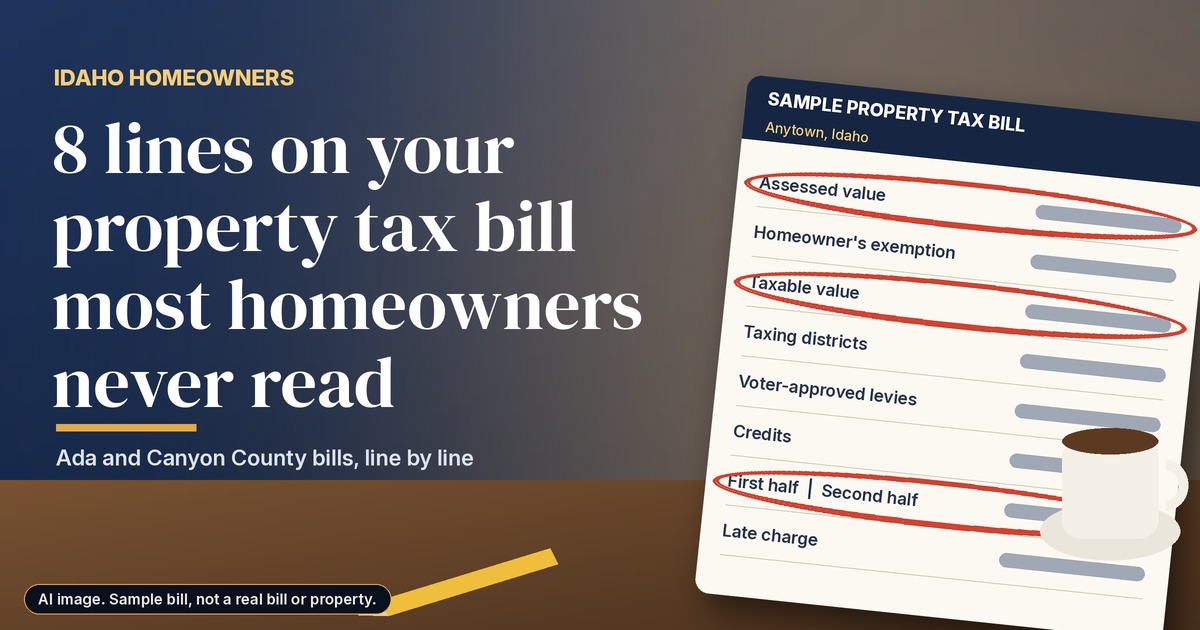
When the property tax bill shows up in late November, it's tempting to look at the total, glance at the due date and file the rest. I've done that too. The rest of the page is a lot of small type.
I walked through the lines you typically see on an Ada County or Canyon County bill, using the treasurer, assessor and Idaho State Tax Commission pages. This is a reading guide, not tax advice, and it's not a guide to claiming breaks. If a line on your own bill looks off, your county treasurer or assessor is the person to ask.
One thing I want you to hold onto as you read: the assessed value on that bill is the assessor's estimate of what a typical buyer would reasonably pay as of January 1. It's not a sale price, and it may not be what your home would sell for now.
1. The assessed value line
What it is: This is the assessor's estimate of market value as of January 1 of the tax year. Idaho law requires property to be assessed at market value as of that date. The Ada County Assessor puts it plainly: the assessor does not set a value for your property. He or she estimates what a typical buyer would reasonably pay for it on January 1.
What it means: It's a tax figure, tied to a specific date. Markets move after January 1, and a later sale can come in higher or lower. If you disagree with the assessed value, that conversation belongs with the assessor. Assessment appeals run on a spring deadline, not when the November bill arrives.
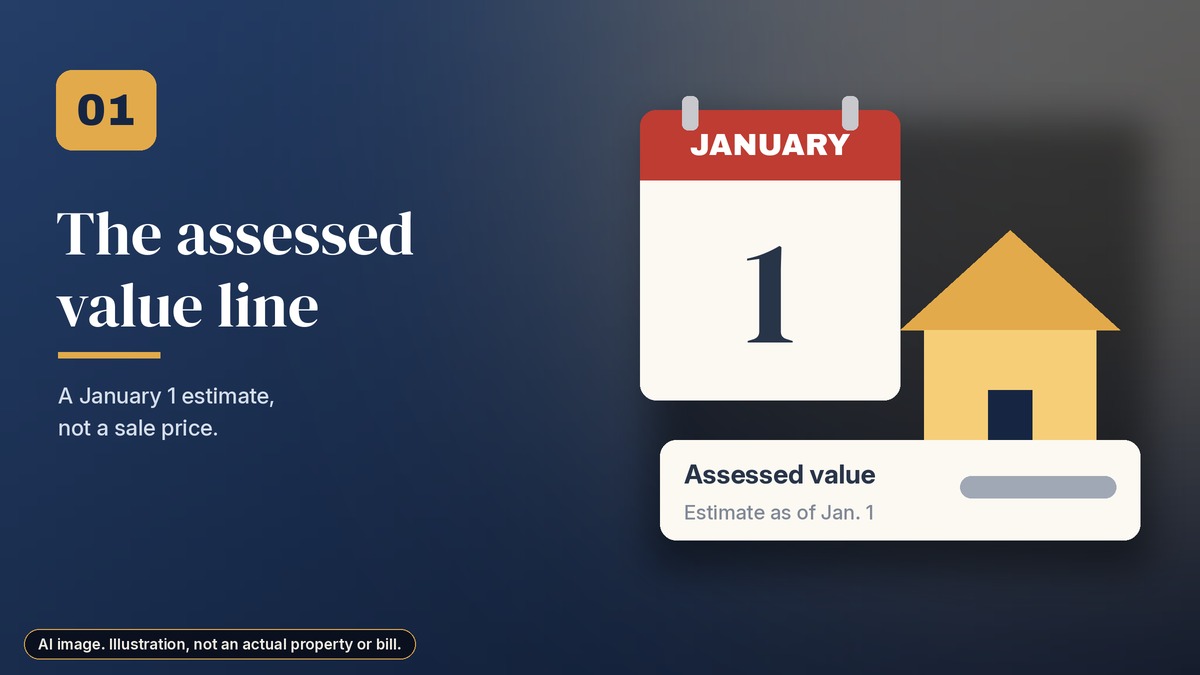
The number on this line is not what your home would sell for today.
2. The homeowner's exemption line
What it is: On many owner-occupied primary residences, you'll see a homestead exemption, also called the homeowner's exemption. The Idaho State Tax Commission and Ada County describe it as 50% of the value of the home and up to one acre of land, with a maximum of $125,000, whichever is less. Ada County's treasurer says your consolidated bill will reflect the exemption if you have it.
What it means: This line reduces the value that tax rates are applied to. I'm not going to walk through how to apply, or how to get a larger break. If the line is missing and you think it should be there, or the amount looks wrong, ask your county assessor.
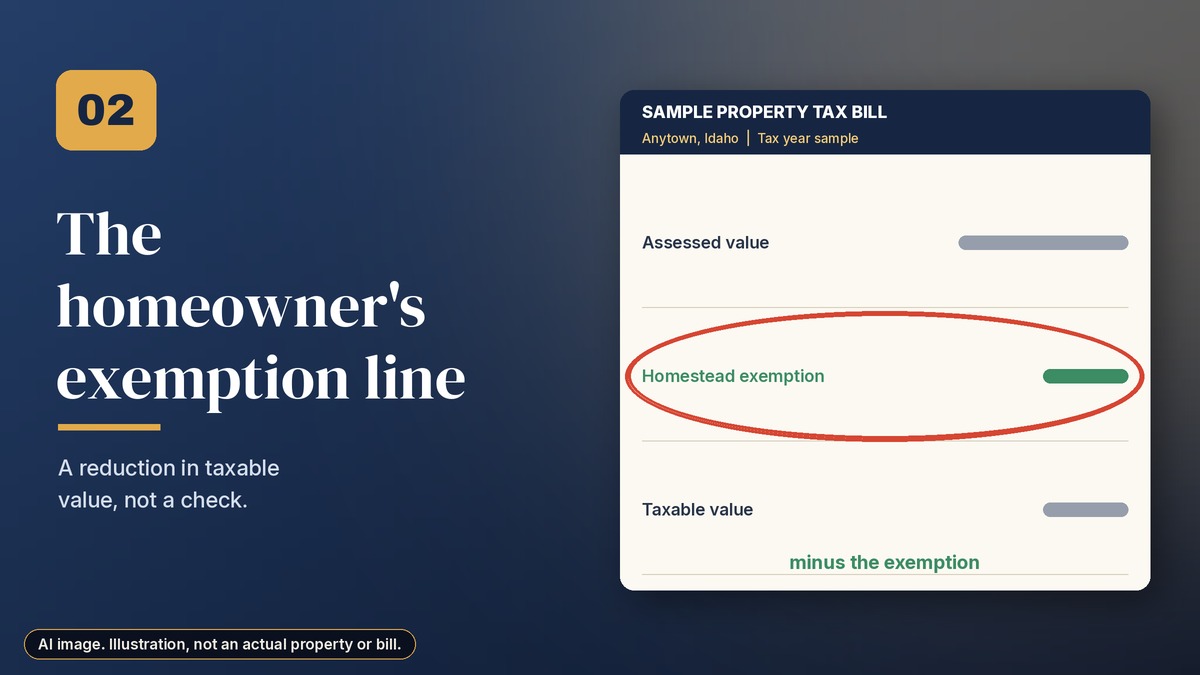
This line is a reduction in taxable value, not a check you receive.
3. The taxable value line
What it is: Taxable value is the assessed value minus any exemptions. The treasurer uses this number, not the full assessed value, to calculate the tax for each district.
What it means: Two homes with the same assessed value can have different taxable values if one has the exemption and the other doesn't. This is still a tax number. It's not a sale price, and it's not what you would net if you sold.
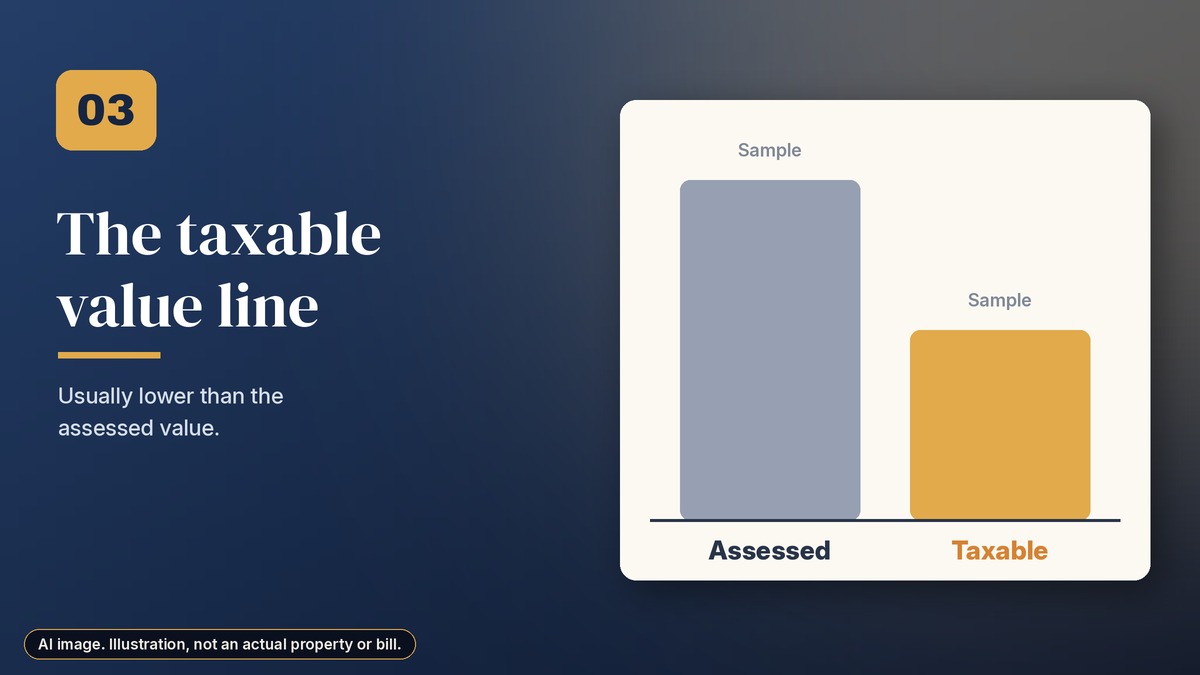
Taxes are calculated on taxable value, which is usually lower than the assessed value on the same bill.
Curious what your home would sell for now? Get a quiet value check
4. The taxing district and levy rate lines
What it is: Your property sits in more than one taxing district. Ada County issues a consolidated bill on behalf of about 40 of them, such as the county, a city, a school district, and special districts like highway, fire, library or sewer. Each district has a levy rate. The Tax Commission explains the rate as the portion of that district's budget funded by property tax, divided by the total taxable value of property in the district. Your bill lists the district, the levy rate and the tax amount for each one. Those amounts add up to your total.
What it means: The State of Idaho doesn't receive your property tax. It stays with local districts. A higher assessed value doesn't automatically mean a matching jump in the bill, because the rate is a budget divided by all the taxable value in that district. If you want the "why" behind a particular line, the district name on the bill is the place to start.
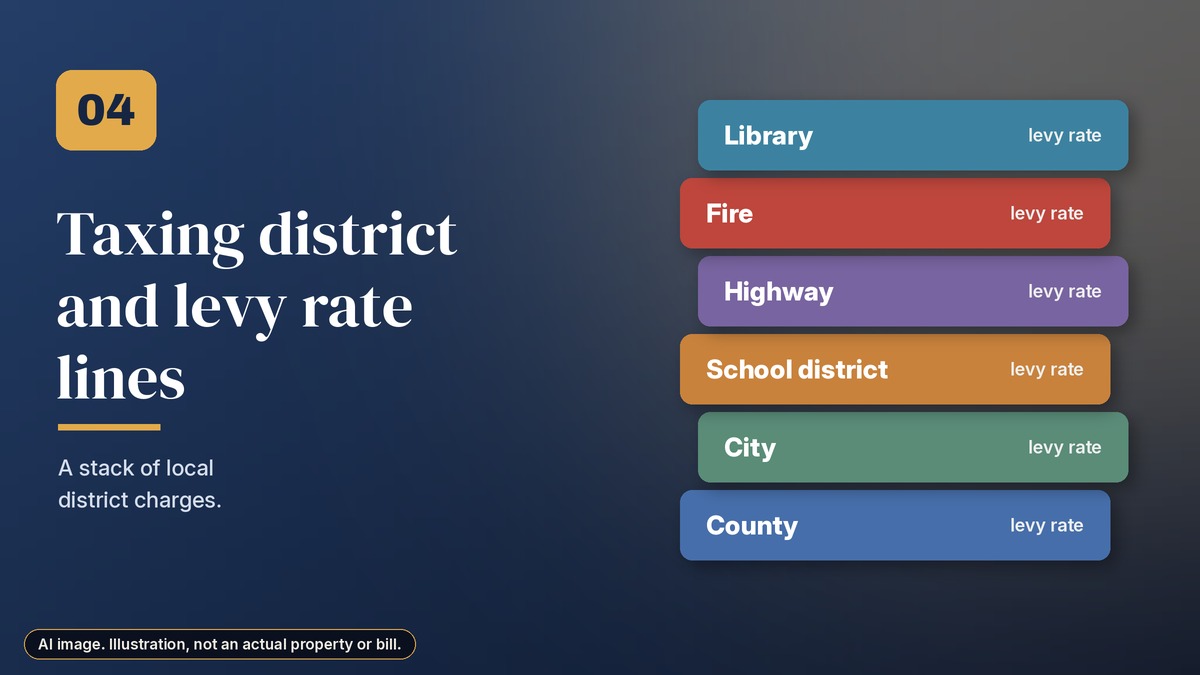
Your bill is a stack of local district charges, not a single state tax.
5. The voter-approved bond and levy lines
What it is: Some of those district lines are the regular levy. Others are voter-approved, such as a bond, a supplemental levy or a plant facilities levy. They show up as their own lines, with their own rates.
What it means: When voters pass or reject a measure, that can change those lines in later tax years. It doesn't always change the bill that arrives the same month as the election. Levy rates for the bill in your mailbox this November were calculated in October.
Election note: In the Nov. 3, 2026, election, Kuna and Caldwell voters approved supplemental school levies, and Middleton's supplemental levy and Vallivue's plant facilities levy did not pass. Vote Idaho now lists those as official results. Both approved levies start with the fiscal year beginning July 1, 2027, so they aren't on this year's bill.
Bottom line: Whatever passed or failed, your bill, not a news story, is what you owe. If you want to see the current rates, Ada County's treasurer posts levy rates by tax district.
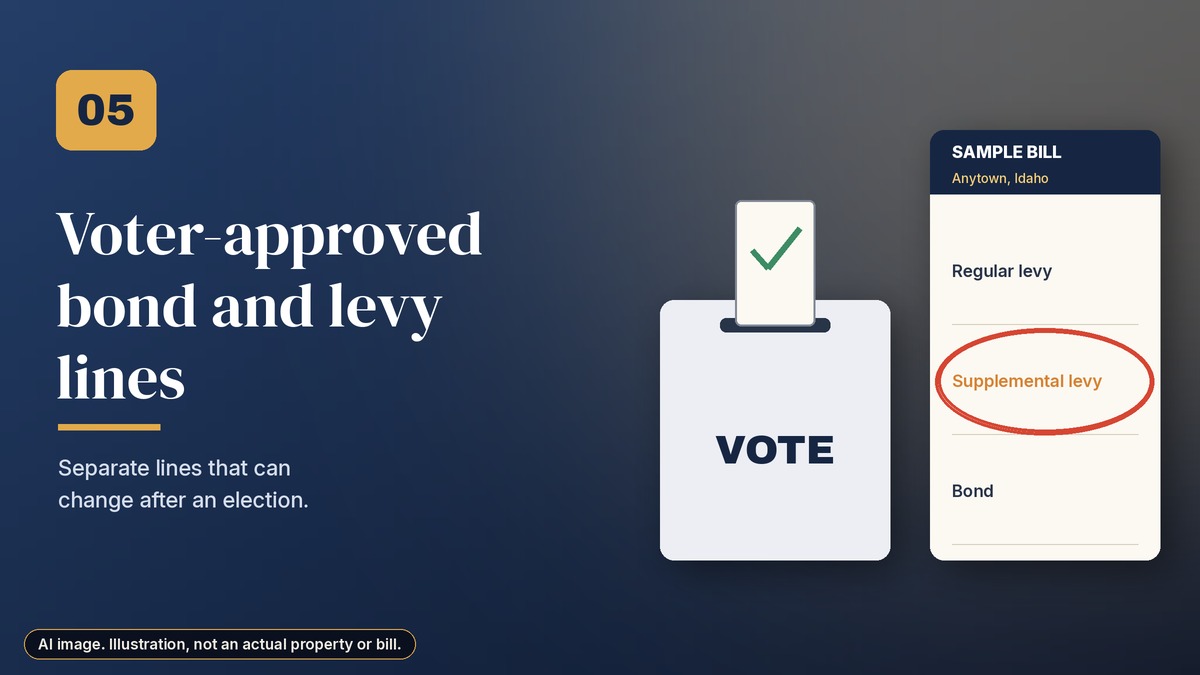
A voter-approved line is a separate charge on the bill, and it can change after an election, usually in a later tax year.
6. The credit or reduction lines
What it is: Some bills show one or more credits after the district charges. Two you may see are the Homeowner's Tax Relief credit and a Property Tax Reduction, also called the circuit breaker.
Homeowner's Tax Relief: Ada County's assessor says the Homeowner's Tax Relief credit is listed on the tax bill for homeowners who already have the homestead exemption, with some exceptions, such as a newly occupied home in its first year. You don't file a separate application for that credit if you already qualify for the exemption.
Property Tax Reduction: The Tax Commission says that if a Property Tax Reduction application is approved, the reduction appears on the December tax bill. That program is separate, and not every homeowner will have that line.
What it means: If a credit is on the bill, it's already been applied. If you expected to see one and don't, ask the assessor or treasurer. I'm leaving the application rules alone here, because this is a guide to reading the bill, not a tax-break checklist.
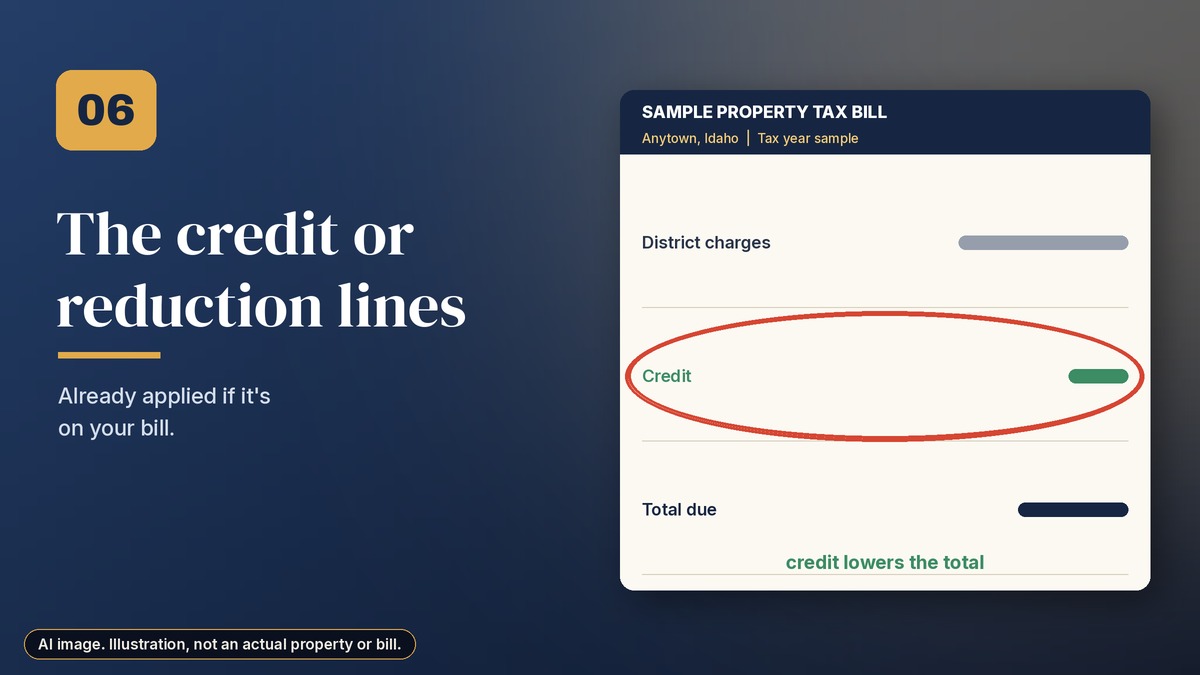
A credit line reduces what you owe on this bill. If it isn't there and you think it should be, ask your county assessor or treasurer.
7. The first-half and second-half amounts
What it is: The Tax Commission says counties mail property tax bills each November. The full year's tax is due December 20, and you may pay half by December 20 and the balance by June 20 of the following year. Ada County's treasurer says the same: you can pay in full or in two installments, provided the first installment is paid on time. Both halves belong to the same tax year.
2026 due dates: December 20, 2026, is a Sunday. Ada County's treasurer homepage says the first installment of 2026 property taxes will be due by December 21, 2026. Its Important Tax Dates page still lists December 20, so go by the homepage notice and your own bill. Canyon County's treasurer homepage says the first half is due December 21, 2026, because December 20 falls on a Sunday, and that payments postmarked on or before December 21 will be considered paid on time.
Practical tip: For mailed payments, Ada and Canyon both say the postmark has to be a USPS cancellation mark. Metered mail isn't accepted, and Ada says pre-canceled stamps aren't either. If anything about your due date is unclear, check your own treasurer's site or the date on your bill.
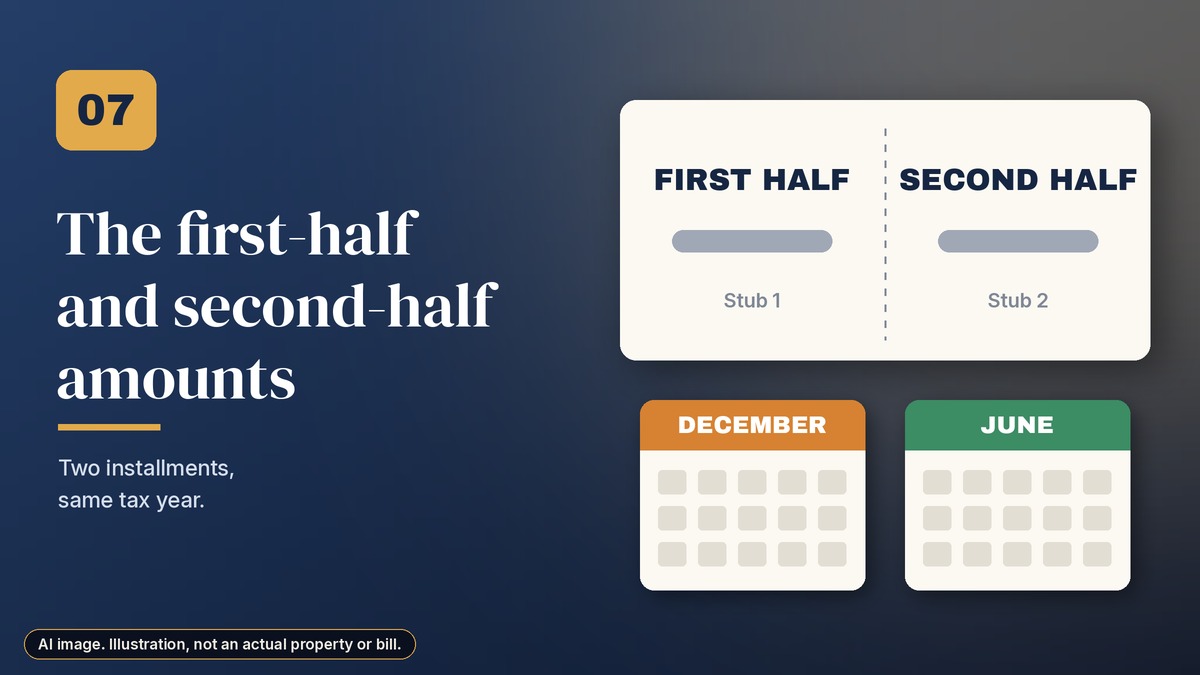
The first half is normally due December 20 and the second half June 20. For 2026, the Ada and Canyon County treasurers both say the first half is due by December 21, since the 20th is a Sunday. Mail early, with a USPS-postmarked envelope.
8. The late charge
What it is: Ada County's treasurer FAQ says that if the December installment isn't paid by the deadline, a 2% late charge is added, along with interest at 1% per month beginning January 1 following the due date. If the June installment isn't paid by the deadline, a 2% late charge is added, along with interest at 1% per month beginning January 1 of the current year.
What it means: Those charges come from the treasurer's process. I can't waive or interpret them for you. Ada County also notes that payments are applied to the oldest tax balance first, so a payment may not land where you expected if anything is already delinquent. If you're unsure how a payment will be applied, call the treasurer.
Missing the deadline can add a 2% late charge and monthly interest. Confirm the deadline and your balance with the treasurer.
If the assessed value has you wondering about your number Get a quiet value check.
If the assessed value has you wondering about your number
That January 1 figure is for your tax bill. If you'd like a straightforward read on what your home might sell for now, I can put a quiet value check together when you're ready.
Get a quiet value checkFrequently Asked Questions
When is the first half of my Idaho property tax due?
The Idaho State Tax Commission says you can pay half by December 20 and the balance by June 20 of the following year. December 20, 2026, is a Sunday, so for 2026 both the Ada County and Canyon County treasurers say the first half is due by December 21. Canyon says payments postmarked on or before December 21 count as on time. In any other county, check your treasurer's site.
Is the assessed value on my tax bill what my home would sell for?
No. It's the assessor's estimate of what a typical buyer would reasonably pay as of January 1. That can differ from a sale price later in the year.
What is the homeowner's exemption line?
It's a reduction in taxable value for a qualifying owner-occupied primary residence. The Tax Commission describes it as 50% of the value of the home and up to one acre, up to $125,000, whichever is less. If the line looks wrong, ask your assessor.
What happens if I miss the December payment?
Ada County's treasurer says a 2% late charge is added, with interest at 1% per month beginning January 1 following the due date. The first installment also needs to be paid on time if you want to use the two-installment option.
Who do I call if a line on my bill looks wrong?
Questions about the value or an exemption go to the county assessor. Questions about the amount due, payments, due dates or late charges go to the county treasurer. I can't interpret your bill for you.
This article is general information about how to read a typical property tax bill, compiled from official county and Tax Commission pages on Nov. 17, 2026. It is not tax, legal or financial advice. Dates, rates, credits and the lines on your own bill can change. Please confirm the details with your county treasurer or assessor. Information is deemed reliable but not guaranteed.
Sources
Sources reviewed November 17, 2026.
- Ada County Treasurer, Important Tax Dates: https://adacounty.id.gov/treasurer/calculation-of-property-taxes/remember-important-tax-dates/
- Ada County Treasurer, Frequently Asked Questions: https://adacounty.id.gov/treasurer/calculation-of-property-taxes/frequently-asked-questions/
- Ada County Treasurer, Calculation of Property Taxes: https://adacounty.id.gov/treasurer/calculation-of-property-taxes/
- Ada County Treasurer, Payment Options: https://adacounty.id.gov/treasurer/payment-options/
- Ada County Treasurer, homepage: https://adacounty.id.gov/treasurer/
- Ada County Assessor, Homeowner's Tax Relief: https://adacounty.id.gov/assessor/tax-relief-programs/homeowners-exemption/
- Ada County Assessor, Real & Manufactured Property Assessment: https://adacounty.id.gov/assessor/property-assessments-records/real-manufactured-property-assessment/
- Ada County Assessor, Assessment Notices and Appeals: https://adacounty.id.gov/assessor/property-assessments-records/assessment-notices-appeals/
- Idaho State Tax Commission, Understanding Property Taxes: https://tax.idaho.gov/taxes/property/understanding-property-taxes/
- Idaho State Tax Commission, Homeowner's Exemption: https://tax.idaho.gov/taxes/property/homeowners/exemption/
- Idaho State Tax Commission, Guidance Memorandum, April 7, 2026: https://tax.idaho.gov/wp-content/uploads/s/IIS00160/IIS00160_04-22-2026.pdf
- Idaho State Tax Commission, Property Tax Reduction: https://tax.idaho.gov/taxes/property/homeowners/reduction/
- Idaho News, Kuna, Caldwell school levies pass as four Southwest Idaho measures fail, Nov. 4, 2026. Early results as of that report.: https://idahonews.com/news/local/kuna-caldwell-school-levies-pass-as-four-southwest-idaho-measures-fail
- Canyon County Treasurer, homepage: https://www.canyoncounty.id.gov/treasurer/
- Vote Idaho, Ada County official results, General Election Nov. 3, 2026: https://results.voteidaho.gov/results/public/ada-county-id/elections/nov2026
- Vote Idaho, Canyon County official results, General Election Nov. 3, 2026: https://results.voteidaho.gov/results/public/canyon-county-id/elections/nov2026
Ben Janke, Associate Broker. IdaListings at Silvercreek Realty Group. 1099 S Wells St #200, Meridian, ID 83642. Call or text (208) 991-2127. Market data: Intermountain MLS (IMLS), October 2026. All figures are aggregate summary statistics and do not describe any individual property. Equal Housing Opportunity.